Muslim Festival of Sacrifice (Eid-al Adha)
|
|
Greetings:
"Happy Eid!",
"Eid mubarak!" (Arabic: Eid = Festival; mubarak = blessed)
"Happy Eid Greetings!"
|
| |
|
Background
The Festival of sacrifice is as important as Ramadan (the Festival of Breaking Fast) in the Islamic society.
Both festivals are mandatory for all Muslims and Islamic schools of law.
The Festival of Sacrifice is celebrated in commemoration of the prophet Ibrahim (Abraham) who, according
to Islamic tradition passed a divine test when he was ready to sacrifice his son Ismael (Isaak) for Allah.
When Allah saw his willingness and faith he commanded Ibrahim to stop. Later Ibrahim, his son Ismail and
friends sacrificed a ram to express their gratitude. (Koran, surah 37, 99-113. Analogy in the Bible, Gen. 22, 1-19)
(Source: Wikipedia)
|
|
 |
|
|
The celebration of this Festival goes hand in hand with a pilgrimage, the Haddsch (pilgrimage to Mecca) which
takes place each year at the same time as the Festival of Sacrifice. One climax of the pilgrimage is the Day of
Arafat, a mountain close to Mecca surrounded by a plain where the pilgrims congregate on the 9th of the Islamic
month Thu al Hidscha. On this day invocations are answered and sins are erased. The celebration of the Festival
of Sacrifice is on the 10th day. Three days later the Haddsch ends and the pilgrims return home where they are
eagerly expected and welcomed with a big festival.
The Festival of Sacrifice is determined by the Islamic lunar calendar. The exact dates of the Festival and
their conversion to the Gregorian calendar depend on Ramadan as it takes place 70 days after that day. Some
schools of law determine the date not only by astronomic calculation but also by the sighting of the new moon
(observation of the moon is only performed at the end of Ramadan which then determines the date of the Festival
of Sacrifice). Each year shortly before Ramadan all scholars watch intently the development of the moon to
schedule the first new moon in the Islamic calendar. All Muslims anxiously monitor the development and wait
for the announcement of the experts. It happens quite often that the scholars are only able to determine the
date a few days in advance, sometimes not before the eve of the festival. It is even possible that due to
geographic circumstances the Festival date varies by one day in different Islamic countries. (source: islam.de)
|
| |
|
How do Muslims celebrate the Festival of Sacrifice?
All devout Muslims worldwide, as far as they can afford it, have the obligation to sacrifice a sheep,
a goat or a camel for the celebration. A sheep in Jordan for example costs between 150 and 250 Euro.
Just as a goose for Christmas, sheep in Muslim countries are the most important commodity around that time,
due to the enormous demand and often have to be imported from other countries. The sacrifice of an expensive
camel is rare. According to availability one also slaughters goats and cattle in dry regions and water
buffaloes in Indonesia and Malaysia.
|
| |
|
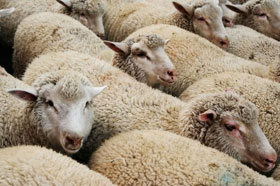
Every year shortly before the Festival of Sacrifice extensive sheep trading and sheep transports take
place. Towns and villages are suddenly flooded with sheep which are often kept on roofs or in cellars or
simply tied in front of the house. In case you visit a Muslim country during that time, and you see and hear
sheep everywhere, you will know that the Festival of Sacrifice is approaching.
|
 |
|
|
Sheep are usually slaughtered on the first day of the Festival. However as the queue of sheep is extremely
long the ritual might last for two or three days. According to Islamic commandment the meat has to be divided
in three parts: the person making the sacrifice may keep one third, the second third is for the needy and poor
and the last third goes to neighbours and relatives. There are however various other rules and possibilities.
The Festival of Sacrifice lasts three days. It is important for all Muslims to visit relatives, friends
and neighbours and exchange good wishes. The visits start officially on the first holiday but one might want
to start one or two days in advance. The visits are usually quite short as the list of relatives and friends
is extremely long - an exhausting assignment resulting in traffic chaos. The mutual visits even last some days
beyond the holidays.
Every household without exception offers visitors tea, coffee and sweets and as a good guest one
has to accept. Even after ten homes and ten cups of tea one should by all means accept a little something
in the eleventh home. A refusal would be an insult to the host who might wonder why his guest won't accept
something to eat or drink; this impression must be avoided at all times. No presents are exchanged for the
Festival but parents give children money or clothes.
|
| |
| |
What significance does the festival have in the business world?
The Festival of Sacrifice is more like a holiday for relatives and friends. Muslim business men however
see it as an occasion to exchange good wishes with business partners and colleagues. One could send greetings
one or two days before the Festival, and greetings can be exchanged by email or on the phone.
We highly recommend sending good wishes to your Muslim partners and colleagues for this extremely important
holiday. Taking into consideration a certain current tendency to condemn Islam at large, good wishes will send
a signal of good will, respect and tolerance and your Muslim partners will appreciate it very much. Express with
a few good wishes that you appreciate the opportunity to greet your colleagues on this solemn occasion.
|
| |
| link to "Greetings Calender" |
| |
Top of page
|
| |
| |