The Celebration of Breaking Fast
(arab.: 'Id-ul Fitr; turkish: Ramazan Bayramî)
|
|
|
| |
| |
|
Greetings:
Arabic:
"Id ul-fitr mubarak" (Have a Happy Holiday of Fast-Breaking)
"Happy Eid!",
"Eid Mubarak" (Have a Blessed Holiday)
"Happy Eid Greetings!"
Turkish:
"herkesin bayramini kutluyorum" ( I wish all of you a Happy Ramadan)
"Bayramini mübarek olsun" (Blessed holidays)
|
| |
| |
| |
|
The Islamic calendar
Islamic countries use two calendars simultaneously. In everyday life as well as in business life the worldwide
known Gregorian calendar is well established. Religious holidays however are determined by the Islamic calendar,
a lunar calendar used since the year of Hidjra (AH=Anno Hegirae).
On the 16th of July 622 the prophet Mohammed and his companions had to leave Mecca and emigrate to Medina.
The islamic calendar started on this very day which was
|
|
 |
|
|
"1st Muharram 1st AH" (the first month of
the first year). That is why the Islamic calendar is also called Hijri calendar (At-Taqwim Al-Hijri).
Contrary to the Gregorian calendar the Islamic calendar uses lunar years. One lunar year consists of
twelve calendar months and is around 11 days shorter than a solar year. Therefore the months of the Islamic
calendar move all the way through one solar year in about 32 solar years (or about 33 lunar years) which is
why Islamic holidays are not always on the same date.
Ramadan for example, the most important religious event in Islam, takes around 34 years to move all
the way back through one solar year which means that each year the date of Ramadan shifts forward.
The conversion of calendar dates
The Islamic calendar starts with Hidjra (622 AD) therefore Islamic countries use different terms
for years e.g. 4 August 2011 would be 04/09/1432 AH.
The most important Islamic religious events last several days therefore it is helpful to have a basic
knowledge about the Islamic calendar so that one is able to plan a project in advance and to manage it
efficiently. In this way you won't be caught off guard either by the holiday planning of any Islamic colleagues.
|
|
There is a lot of information online about the Islamic calendar
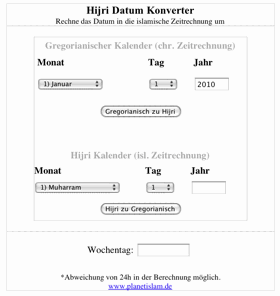
1) The website of "Planet Islam" offers a useful "Hijri Date Converter".
Link: http://www.planetislam.de/hijri-kalender
2) In Arabic newspapers you will usually find two calendars (the Gregorian and the Islamic) on top of the website.
Here are two examples
http://www.arabnews.com/
http://www.aljazeera.net/portal/
3) Informations about the correct prayer schedule for all Muslims according to their whereabouts:
http://www.islamicfinder.org/
|
 |
to the top |
|
3. Ramadan and the commandment of fast
Background
The ninth month in the Islamic calendar (Arabic Ramadan) is the month of Lent. As religion determines a major
part of Islamic daily life certain months are particularly important. Besides Ramadan this is the month Dhu
l-Hiddscha
(the 12th month).
The most important religious events take place during these months. Ramadan means fasting, Dhu l-hiddscha is
the month of pilgrimage (hadj). For Muslims they have a similar significance as holy mass and are part of the five
pillars of Islam which are according to the Koran mandatory for all believers .
Every year both events come to an end with a big celebration - one is the festival of Fast-Breaking, the other
the Feast of Sacrifice. The significance of both ceremonies is similar to Christian Easter and Christmas.
How to behave during Ramadan
Lent or fasting starts on the first day of Ramdan (in Arabic: Saum). During the entire month eating, drinking
and smoking is not allowed between sunrise and sunset.The correct approach to Ramadan includes to keep away
from sinful activities even more than usual. One should not look at anything morally reprehensible, speak no
evil, listen to no evil and do no evil. Collective fasting for 30 days shows special devotion to Allah (by deeds)
as well as discipline and being conscious of one's own religious beliefs (www.religion-online.info). According to
the Koran fasting is mandatory for all Muslims, it should be done in the name of God (Allah) and in this way
earn the contentment of Allah. Devout Muslims read the entire Koran during Ramadan several times from beginning
to end.
|
|
Besides the aim to please Allah fasting is basically a healthy activity. It includes a reasonable approach to
nourishment, which means to eat consciously as well as healthy food. In the evening one should eat light meals
which contain a lot of liquid and are easy to digest. This however doesn't mean that Lent is the time to
automatically lose weight. There are believers who even gain weight because they indulge too much in the meals
of Lent.
|
 |
|
Children, sick persons, pregnant women and other special cases are exempt from fasting. The same goes for
travelers who should eat normal. All persons who for whatever reasons don't fast during Ramadan should make up
for it by fasting at some point during the rest of the year.
Muslims love to be together with the family or in groups. In the evening they meet to break fast (iftar)
with relatives, friends or neighbours. They eat together or visit a mosque whith its nightly prayer
sessions during Ramadan. The common mutual greeting during this month is: "Ramadan Kareem" (which means "A generous
Ramadan") the answer is: "Allahu Akram" ("God is the most generous").
The culmination point of Ramadan is the "Night of Destiny" (Lailat al Qadr). which is the most holy night in
the Islamic calendar when according to Islamic belief the Koran was revealed for the first time. The exact date of
the Night of Destiny is a bit uncertain and is determined by the odd numbers of the last ten nights of Ramadan: 20
to 21, 22 to 23, 24 to 25, 26 to 27 or 28 to 29. Different schools of law set Lailat al Qadr on different dates.
Sunni countries usually celebrate the night of 27 Ramadan. According to the Gregorian calendar Lailat al Qadr 2011
is the night of 26 to 27 August.
(In most Islamic countries the majority of Muslims are Sunnites with the exception of Iran, Iraq, Bahrain,
Azerbaijan, Oman and Libanon)
At sunset on the last day of Ramadan all Muslims have fulfilled their obligations. They eat a date or drink
some water and say a short prayer which signifies the break of fast. In villages and communities people often
celebrate together. The month of Lent is officially over and celebrations can begin and last three days (Id-ul Fitr)
in the entire Islamic world.
|
to the top
|
|
The exact date
The first day of Ramadan celebrations 2011 is 30 August.
Some law schools determine the exact date not only by astronomic calculation but also by the sighting of New
Moon which again determines the date of the Feast of Sacrifice.The scholars and all Muslims watch with intense
anticipation the development of the moon and wait for the first visible sickle moon (hilal). Due to geographic
conditions the festival does not start in all Muslim countries on the same day.
The celebration of breaking fast
|
|
Domestic and social aspects dominate the celebration. On the first day
(1.Schawwal, 10 month) all men dress well and go to the mosque for the ceremonial prayer.
Women are also allowed in the mosque however somehow over the years a custom developed that women could also pray
at home. They probably prefer it anyway because it gives them time to prepare the dishes for the traditional big
breakfast after the ceremonial prayers. After the prayer and the sermon the men wish each other well and hope that
Allah is pleased.
|
 |
|
Countless visits, greetings and blessings are excanged during the entire day. One visits friends and relatives
including those who live further away as well as the graves of the deceased loved ones. According to custom the
younger family members visit the older ones to wish them "Eid Mubarak" (a blessed holiday). During the days of
celebration the phone companies' turnover is staggering as cell phones ring all the time and millions of text
messages are exchanged.
|
|
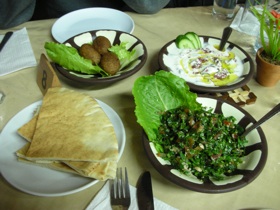
Even those who like fasting should stop now - there is no chance to stay on a diet as tables are full of
delicacies prepared by grandmothers, mothers, aunts and sisters. Nobody would dare to refuse.
During Ramadan children have more liberties than usual. The end of Ramadan is their happiest day when the adults
give them little gifts like money and sweets. Sweets are very popular which is the reason why the celebration in
Turkey is called "Sugar Feast".
|
 |
| |
nach oben
|
| |
Social aspects
Although fasting is a tiring exercise the general atmosphere during the month of Lent is joyful and relaxed.
It is a time of contemplation for all adults and children have more liberties than normal. Arabian families have
a very loving attitude towards their offspring. Children don't have to fast but they are gently guided and
encouraged to gradually try it. In that way they learn how to judge situations and how to deal with food consciously
and respectfully.
During Ramadan evervbody should try to strengthen a feeling of solidarity towards all fellow human beings.
During this great social event and according to tradition everybody should be generous with donations. These are
meant to be additional donations on top of the one which is a certain percentage yearly of everybody's income (
Zakat al fitr) for the poor and needy. The amount for these mandatory donations vary from country to country -
in some regions it is 2,5%. The spirit of Ramadan regarding donations is similar to the spirit of Christmas in
the Western World. Nobody should go hungry at least during the celebrations. In this way the Islam fulfills its
claim for social justice.
Another requirement of Ramadan is the enhancement of interpersonal relationships because the values of fasting
include ethical compliance which means not to badmouth other people. Ramadan is furthermore the month of
reconciliation and all disgreemenst should be solved. One should be patient with others and withstand all provocations.
|
|
In theory all Muslims have the obligation to fast and most of them obey the commandment due to their belief in
Allah and their conscience. Members of other religions and non-observant Muslims try to respect this tradition.
Not every Muslim fasts and observes all regulations. However everybody should try to avoid certain things during
the month of Lent or at least be less obvious about them e.g. smoking and drinking alcohol. The latter is forbidden
in many Muslim countried (haram=prohibition).
|
 |
|
Breaking the rules should be done tactfully. There once was a case of some youngsters who drank alcohol
during one night of Ramadan. However at sunrise they complied again with the rules of fasting.
|
| |
to the top
|
| |
The meaning of fasting in the business world - how to handle it
Although daily life and work continues as usual during the month of fast it is quite tiring. Support your
Muslim partners and friends by reducing physical work. Try to comply with their wish for flexible working time
in mornings and evenings. The celebrations of Fast-Breaking and the Feast of Sacrifice which follows 70 days
later are of the same significance as Christmas and Easter for Christians. At the end of this month they should
have the opportunity to participate in the ceremonial prayers. In general be prepared that during this month
it's quite impossible to make business appointments.
Don't be surprised if your Muslim colleague is still not back at work a few days after the feast. Don't get
angry but take precautions. The reason for his unforeseen absence might be his parents who live in a distant
location in the countryside or he might have a huge circle of relatives who live far away from each other.
Custom requires to visit all relatives if possible. Therefore your colleague has to travel around a lot
and he won't be able to relate to your lack of understanding.
The best and most important thing to do is to congratulate him on the occasion. Leave it at that, don't ask
too many questions and accept the situation as it is.
|
| |
 |
| |
|
Avoid if possible all important projects during the month of Ramadan or at least take it easy. Even if there
is a very urgent project try not to push it through no matter what. It gets you nowhere. Coordinate a detailed
course of action well in advance with your partner or colleagues and work out a realistic schedule. He will
somehow find people willing to work and take care not to jeopardise the project. After all you displayed social
competence and showed him that you are a good and reliable partner.
Try to understand the significance of Ramadan, be a considerate guest in Muslim countries, respect customs
and avoid to smoke in public. It's in general a polite gesture to eat drink and smoke in separate locations where
no fasting persons are present. Your Muslim colleagues will appreciate your efforts. When you show respect and
consideration, they will judge you as a worthy person and accommodate you as much as possible.
Greetings and congratulations on this occasion are always appreciated. Take the initiative if you want to
intensify the contact with your Muslim partner, if your last contact was a while ago or if your last meeting did
not go so well. Send him a nice message: "Eid Mubarak". The main thing is that you mean it and soon you will
experience a positive feedback.
See top of page for the most common phrases and greetings.
Autor: Joanne Huang
Consultant: Jasmin Naber
|
| |
| link to "Greetings Calender" |
| |
to the top
|
| |
| |