|
On the night of New Year's Eve, families gather in front of television to watch the traditional song
competition "Kohaku Uta Gasse" of NKH. It's broadcasted every year, lasts four hours and is a contest of
female singers of the 'Red-Group' against their male counterparts of the 'White-Group' who sing the "Best of
Songs" of the year. It's a great honor to participate in the Kohaku where only the most famous singers are
invited. After the show it's time to eat Soba-noodles as a symbol of longevity, just before starting the
count-down to the New Year.
Exactly at 12 midnight all Buddhist temples ring the bell 108 times to symbolically banish the 108 Buddhist
sins. All Japanese who are still able to do so hit the road now, not to go to the temples but to the various
shrines to pray for good luck. The perfect interaction of different religions strengthens the feeling of
harmony and ensures twice as much luck. The next morning those who already recovered from New Year's night
get up early to visit the shrine before breakfast.
Japanese often worship a special shrine of a special God. Normally one prays for luck and health so that
the New Year will be peaceful. One writes a wish on a little wooden panel (wishing panels) and hangs it at
the shrine so that the gods will grant the wishes.
An open fire is lit in the yard of the shrine. Visitors throw old tarisma in the fire to say farewell to
the old year and to cleanse themselves from past misfortune. Only in a shrine can one get tarismas which
are pocket book sized lucky charms made from cloth and paper. Each contains a fortune note. One takes the new
tarismas back home and hides them on the home altar for the coming year. Some Japanese also bring dried squid
to the shrine where they collectively barbecue it on the fire in the yard. One divides the squid by hand in
strips and eats it standing up which is said to bring good luck.
A New Year signifies a new beginning. 86 percent of Japanese are Shintoists and 73 percent Buddhists.
Therefore there can never be enough luck and by performing the proper deeds they try from day one to steer
the New Year on a lucky path. One drinks ama-sake, visits a shrine or temple (hatsu-mode) witnesses the first
sunrise and similar activities. Hatsu-yume (the first dream) of the Fuji-mountain, a falcon or an eggplant
signifies an especially good omen. Japanese believe that such dream contents are indicators of an
extraordinary good year. The Japanese word for eggplant is nasu which also means 'success' and 'to get
something done'. A dream of several eggplants is therefore extremely promising.
On the first day of the New Year parents and relatives give money as a present to the children (Otoshidama).
For all children this is the lucky day when they can collect a big amount of money according to the quantity of
relatives. Toddlers and pre-schoolers get between 300 and 500 Yen (exchange rate: 1Euro=around 100 Yen). The
amount increases for first to third graders to between 1000 and 3000 Yen, forth graders and older children get
between 3000 and 4000 Yen and university students might receive up to 30,000 Yen (Euro 300). The quoted amounts
apply per relative and can vary according to the financial situation of the person concerned. As soon as the
children go to work they offer their parents little money gifts as an expression of gratitude.
|























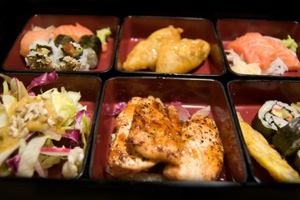 Osechi-Ryori